

Just over a year ago, while browsing the Glycine Store Europe website, something in the Airpilot collection caught my attention. Not a product page or a press release but a small, low-resolution thumbnail of a watch that didn’t officially exist yet.
That watch turned out to be the Glycine Airpilot 41 Automatic, and even in that blurry preview, it stood out.
From that moment on, I kept wondering when Glycine would finally release it. Now, the wait is over.
The Airpilot collection
Glycine introduced the Airpilot line only a few years ago. It was Glycine’s fresh take on the pilot’s watch concept, other than the well-established Airman.
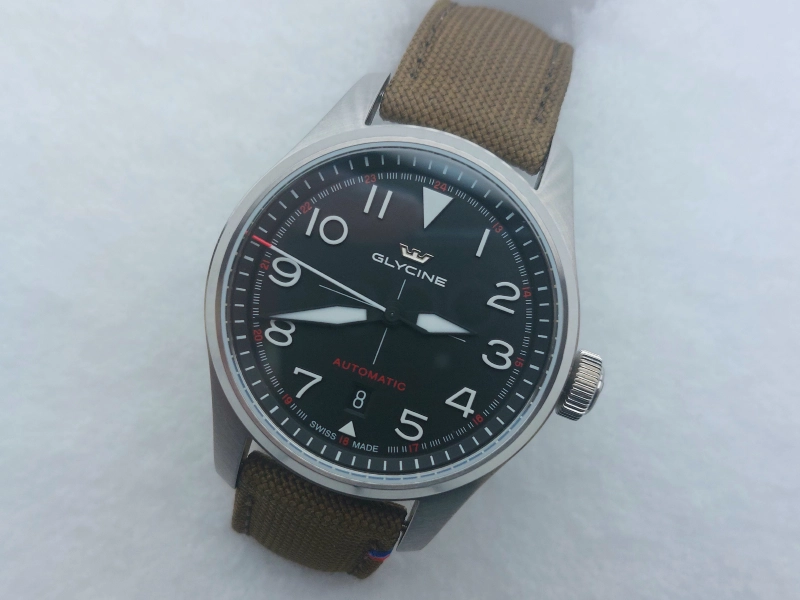
As with most pilot watches, the Airpilot drew heavily from familiar and iconic design cues. The dial layout blends elements from both Type A and Type B versions of the legendary Luftwaffe-issued Beobachtungsuhr (B-Uhr), while the handset closely resembles that of IWC’s Pilot collection, which itself is a derivative of the Type A B-Uhr.
To keep the Airpilot firmly in the budget-friendly category, the collection initially launched exclusively with quartz movements. And in true Big Pilot fashion, every model came in at a bold 44mm.
All models featured complications: big date and dual time subdial, chronograph, or GMT with an internal rotating bezel.
The result was something that, at first glance, was yer token pilot watch, but with enough clever design and complications to make it nothing like yer token flieger, all in a worry-free, accessible quartz package.
As for me, well… While I don’t mind quartz, I do mind the 44mm size. I simply can’t pull it off.
So when I first spotted that blurry thumbnail, I couldn’t help but hope it would break away from the Airpilot’s oversized proportions.
As it turns out, that hope wasn’t in vain.
The dial and hands
The new Airpilot 41 comes in a wide range of colorways: classic black, full “blackout,” olive green, two blue variants – one on a NATO strap and one on a steel bracelet – and even a silver “bullseye” dial with a contrasting black rehaut.
Me? Well, if you’re a regular reader of Waha, you already know how this goes.
When it comes to tool watches, my dial color preference is the one Henry Ford famously offered for the Model T: any color, as long as it’s black.
I’ve made perhaps one kind exception for the blue Combat Sub 41 Ceramic.
Right off the bat, I’m very happy that Glycine chose to upgrade this new version with more than just the movement. Much like with the Combat Sub 41 Ceramic, they really went to town on the new dial.
Where the standard quartz Airpilots rely on an entirely printed layout, the automatic version throws that approach out the window. Instead, we get a raised rehaut with the minute track, applied indices framed in black, and – very welcome – the return of an applied logo.
The numerals themselves are also brand new; the only element carried over from the quartz models is the familiar triangular marker at 12.
The result is, I must say, very pleasing.

The black applied numerals and matte black hands create the illusion that the luminous surfaces are floating above the dial, almost as if they’re suspended in mid-air. I can’t say how pronounced this effect is on the other color variants, but on the black dial, it’s genuinely striking.
At first glance, it’s a simple dial. However, apart from the aforementioned three-dimensional upgrades, they also did quite a lot to the printed features.
A thin crosshair adds a subtle cockpit-instrument vibe, while small touches of red – the “Automatic” text and the tip of the seconds hand inject just enough contrast. Look closely, and you’ll notice that the seconds track even hides tiny 24-hour markings at each index.
I’m also glad Glycine chose to place the date at six o’clock, rendered as white text on a black background. It’s there, it’s legible, but at the same time, it’s clean and integrated well into the design.
The lume
As is so often the case, the lume could be better. However, it’s not bad.
The initial glow is relatively weak, but the BGW9 – yes, it’s BGW9 with that cool, blue glow – seems to retain a decent and lasting base glow. That’s not ideal in low-light conditions, but in the absence of artificial light, that base glow will get you home.
If you’re camping in the wild or wake up in pitch-black darkness in the middle of the night, you’ll be able to read the time clearly.
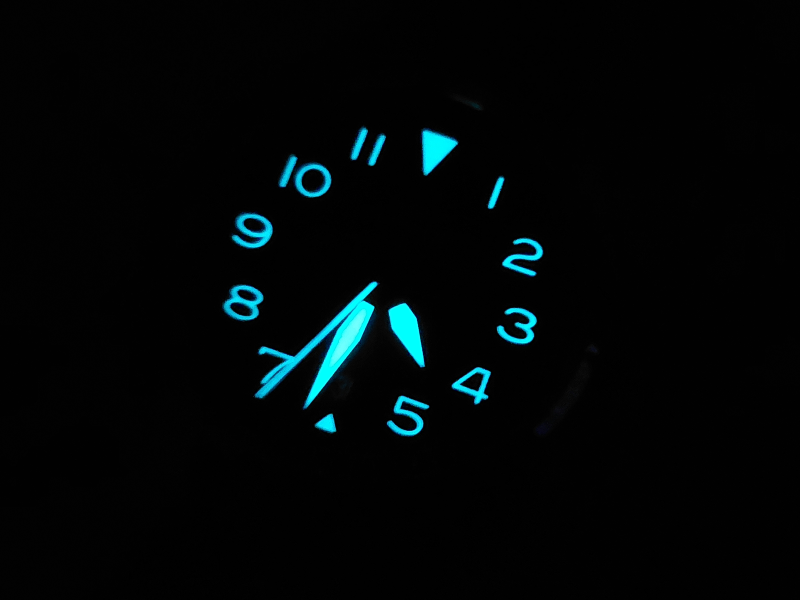
One quirk of this lume that I’ve noticed is that it has a rather weak response to warm artificial light, but sunlight and relatively strong cold-ish LED light charge up the base glow for a long time.
If you drive from the sunlight into a tunnel, whenever shadow falls on the watch, you’ll see the blue glow alright.
In low-light conditions, the seconds hand and numerals lose the initial glow fast, but the hands and the triangle at 12 retain it. So, I guess that in the end, it’s alright. The lasting base glow and how responsive the lume is to sunlight definitely make a difference.
The case
While the step down from 44 to 41mm makes a world of difference in day-to-day wearability, make no mistake: this watch doesn’t wear small. My calipers put the lug-to-lug length at 52mm, which is nearly 3mm longer than the Longines Spirit 40mm.
In terms of proportions, the closest comparison is the IWC Mark XVIII, with its 40mm case and 51mm lug-to-lug.
At 52mm, the Airpilot 41 is very much in Longines Legend Diver territory.
That said, the numbers don’t tell the whole story. Thanks to a relatively slim caseback and strongly curved lugs, the watch hugs the wrist nicely. The center of gravity also sits quite low, so it never feels top-heavy.
When it comes to finishing, Glycine has done a great job.
The edges are crisp, and the contrast finishing on the three facets of the bezel gives it the visual extra depth.
The circular brushing on the top surface, paired with horizontal brushing on the case flanks, immediately brings the Longines Spirit to mind. Granted, not nearly as razor-sharp, but then again, there’s a price difference of well over €1,500 between the two.
Still, the overall approach to contrast finishing is surprisingly similar.
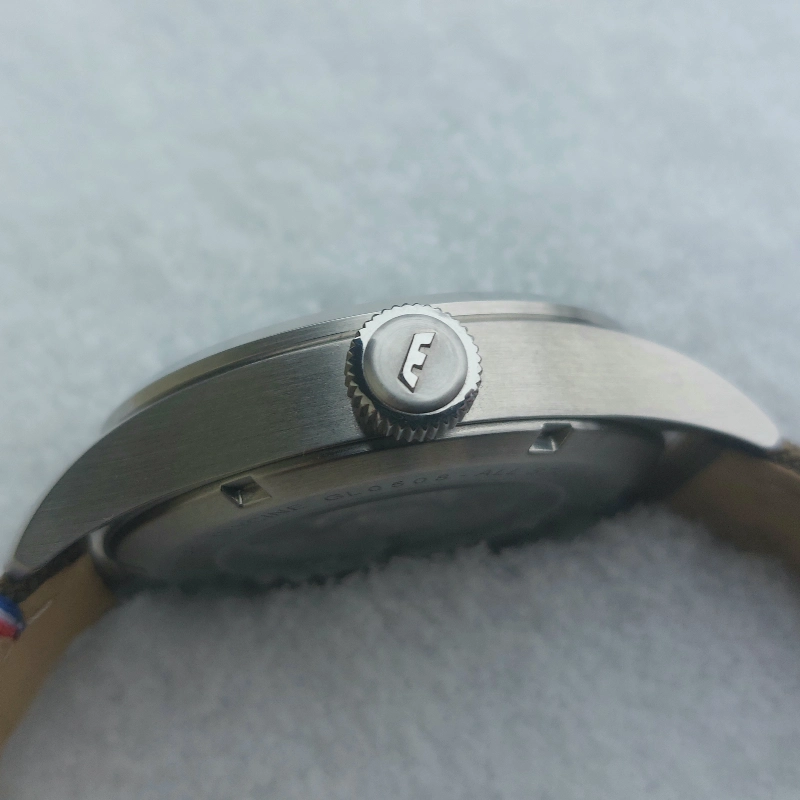
Unlike the more affordable Combat 6 field watch, the Airpilot offers 100 meters of water resistance and a screw-down crown.
The crown itself is particularly well executed: mostly polished, with a domed, circular-brushed section and a raised, polished logo on top. From a practical standpoint, it’s reassuringly large and provides a good grip.
The bracelet
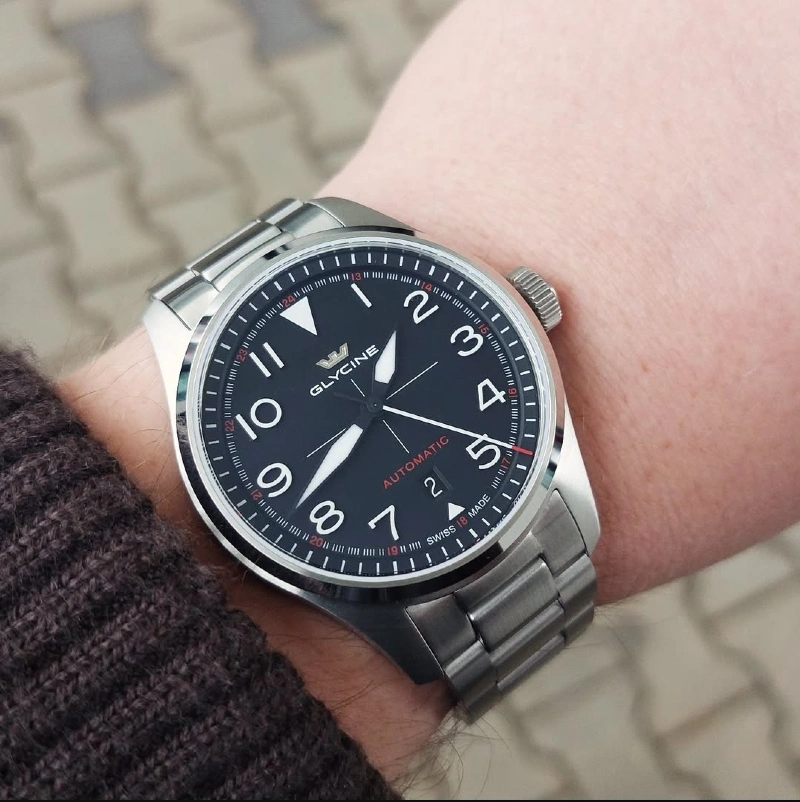
The black dial version – unlike the blue – comes exclusively on a steel bracelet, unless you opt for the black PVD case on a NATO strap.
Fortunately, it’s a good bracelet.
The clasp is identical to the one used on the Combat Sub 39 and likely on several other Glycine models: milled on the inside, stamped on the outside, and equipped with three micro-adjustment holes.
That’s where the similarities to other Glycine bracelets end, though.
Instead of the familiar split-pin system, this bracelet uses pins and sleeves. Specifically, the sleeve sits in the central link rather than the outer links, as you’d see on Seiko or Citizen bracelets.
It’s not the easiest system to size, but it’s far from the worst, and it’s notably more secure and durable than split-end pins.
Ideally, you’d size it using a bracelet vise, but a simple pin punch and mallet will get the job done just fine. It’s exactly how I adjusted this one.
Add to that the inclusion of reasonably short half-links, and getting a precise, comfortable fit is refreshingly easy.
The fit of the end links to the case is stellar. Seriously, those tolerances are easily Longines Spirit–level.
Compared to something like the Combat Sub 39, the difference is night and day.
There is, however, a downside.
That near-perfect fit comes back to bite you the moment you want to swap the bracelet for a strap. Unfortunately, you can’t have it all.
What I really wish Glycine had included here are drilled lugs or a quick-release system. While the brand usually at least opts for drilled lugs, that’s not the case this time.
As a result, switching between bracelet and straps is anything but straightforward. Trust me, a fair amount of Polish profanity was involved when I removed the bracelet.
Actually, that’s an understatement; it scared my cat away.
Another quirk of the bracelet lies in the end links.
From the stock photos, you’d think they’re female end links. That’s partly true, because the first centre link is attached to the end link and the lugs via the spring bar.
In practice, though, the construction behaves more like a two-piece male end link. That first center link is effectively locked against the inner surfaces of the end-link slot, extending the bracelet’s effective length.
Combined with the Airpilot’s substantial lug-to-lug measurement, this isn’t the most practical solution from a fit perspective.
On my wrist, just over 7 inches in circumference, it’s not an issue. But on smaller wrists, it could be less forgiving.
It curves down even more so than the lugs, so it follows the shape of the wrist. At least in my case, it does.
So yes, as bracelets go, I really like this one. That said, I enjoy the Airpilot 41 even more on a strap. I paired it with an Avel & Men sailcloth strap, and I have a feeling it’s going to stay that way for quite a while.
The movement
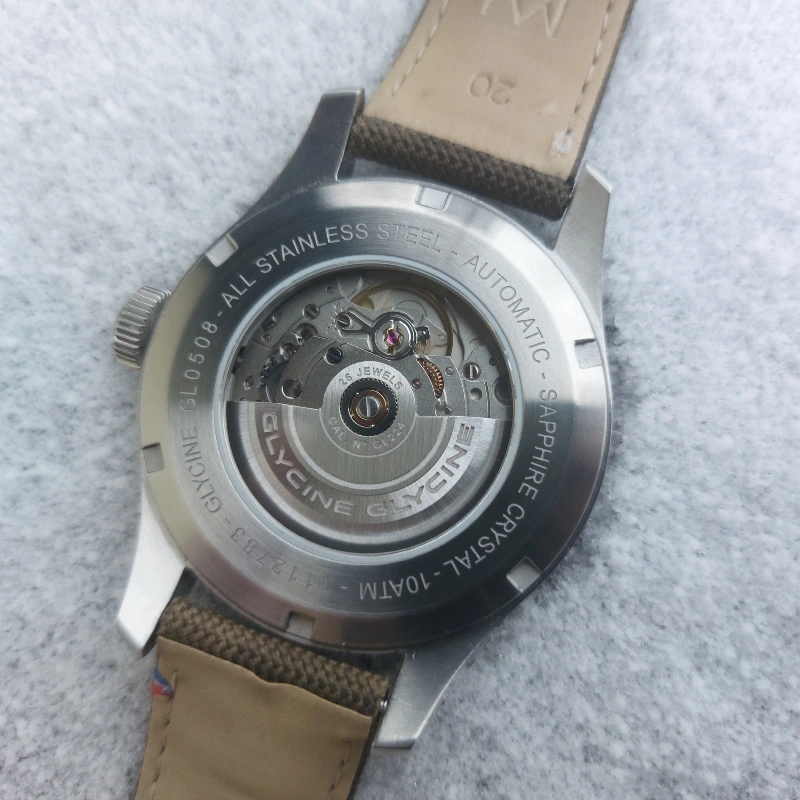
No surprises here. It’s the Sellita SW200. In this example, accuracy sits at around +6 to +7 seconds per day, which is decent.
If you wear it all the time, and thus isochronism won’t kick in, it’ll be two weeks until it’ll be off by a minute.
In the Airpilot 41, the movement is visible through a display caseback. It’s nothing particularly special – the SW200 rarely is – but it fits the overall aesthetic of the watch perfectly.
Final thoughts
I think Glycine, once again, did a great job.
They managed to create a fresh pilot watch design that’s, in some ways, similar to the Longines Spirit, the IWC Pilot Mark-series, perhaps also the Oris ProPilot, with a touch of the Explorer in the form of that triangular index at 12.
At the same time, the Airpilot 41 is its own thing that doesn’t copy any of the above.
It’s not easy to make an original pilot watch without making it look too much like another watch already on the market, and Glycine clearly pulled that off.
Even with its reduced size compared to the rest of the Airpilot lineup, this is still a watch that wears large.
While an even smaller version could certainly make sense as a future addition, I’m personally perfectly happy with the 41mm.
On the wrist, it wears much like the Longines Spirit 40mm or the IWC Mark XVII/XVIII, and both of those have plenty of fans with wrists smaller than mine.
At €595 for the bracelet versions, the Airpilot 41 offers a lot of watch for the money. If you can’t, or simply won’t, spend over €2,000 on a Longines Spirit or an Oris ProPilot, and absolutely won’t stretch to an IWC, this makes for a genuinely compelling alternative.
You can get yours at the Glycine Europe store.
Technical specs – ref. GL0508
- Diameter: 41mm
- Lug to lug: 52mm
- Thickness: 11.15mm
- Lug width: 20mm
- Case material: 316L stainless steel
- Crystal: Sapphire, flat, with ARC on the underside
- Water resistance: 100m/10ATM/10bar
- Movement: Sellita SW200-1 A – bi-directional rotor automatic, 28800 A/h, 26 jewels, date, hacking seconds + hand-winding, power reserve circa 41h (as stated by Sellita)
- Bracelet: 3-link, solid end links, solid links, pin-and-sleeve system, twin-pusher clasp with safety latch and 3 positions for micro-adjustment
- Lume: BGW9 (blue glow) white Super-LumiNova
- Price: 595 euro (at Glycine Store Europe)


I like that watch!
Great review, covered everything without kissing any arse…😄
Nice review!