
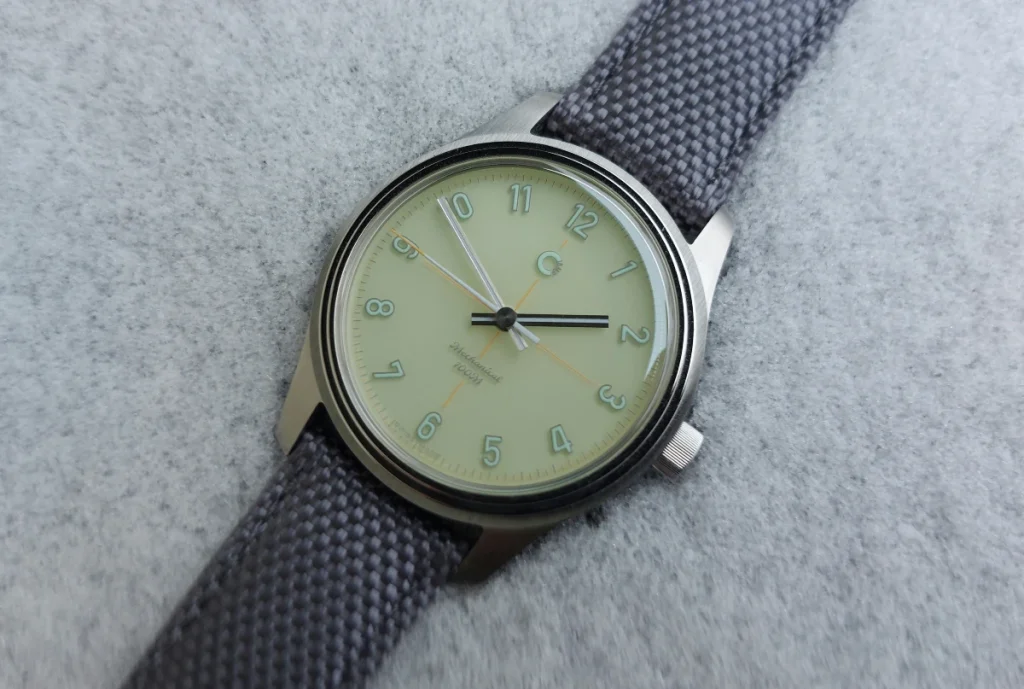
At Waha, we have a soft spot for original, fresh design – and microbrands deliver that in spades. Add a strong connection to car culture, and we’re instantly interested.
So when we came across the Camp Fieldtimer, a watch inspired by one of America’s true hotbeds of automotive passion, we knew it deserved a closer look.
Camp Watches
Camp was founded in Los Angeles by Justin Jakobson, an industrial design veteran with an impressive 25 years in the trade. It may be a young brand, but as the watch reviewed here shows, it’s an ambitious one.
Especially in the field of manufacturing techniques and materials used, Camp definitely is something special.
The Fieldtimer
Camp’s very first watch, the Fieldtimer, is – at least on paper – rooted in the classic field watch formula. Bold Arabic numerals, a straightforward handset, a hand-wound movement: all the familiar ingredients are there.
But dig a little deeper, and the story shifts. As the backstory behind each of the three Fieldtimer versions reveals, this isn’t really a field watch at heart. It’s a car-inspired one.
Now, Fieldtimer is a great name, no doubt about it. Still, I can’t help but wonder whether something like Roadtimer might have been closer to the mark. Because when you look at the watch, it doesn’t quite fit neatly into the field watch box, despite borrowing a few of its traits.
Then again, that might just be me overthinking things.
The dial
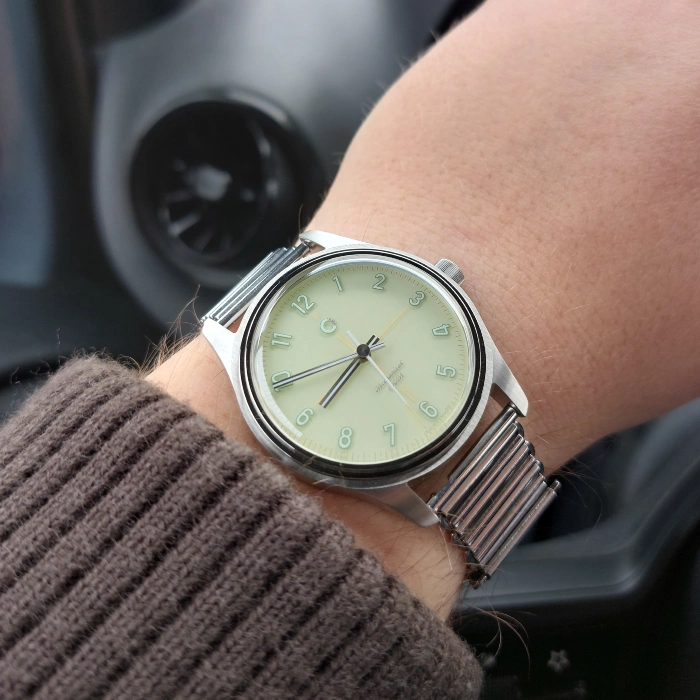
The version reviewed here is the Florida Green. It’s a very light shade of green with a subtle yellowish tint that I’d personally describe as pistachio green.
So, where does Florida play into this? Well… A car brand once used this exact color on one of its truly legendary models.
That brand is BMW, and the car in question is the 02 Series Neue Klasse (“New Class”), first introduced in 1962.
The Neue Klasse was a legend in its own right. It was the car that saved BMW from financial trouble that the company faced in the early 1960s, and then it served as the basis for one of BMW’s craziest (at the time) production cars, the 2002 Turbo.
In the spirit of the era, the Neue Klasse color lineup featured pale, but vibrant pastel colors – and Florida Green was the rarest of them.
However, the dial’s car cues are far from over at just the color having been used on a classic car. The lacquer, complete with the massive layer of clear-coat, is by Berlac – a Swiss company that specializes in car lacquer clear-coats for coach parts that are the most exposed to pebbles and gravel, road salt and all that tends to wreak havoc on paint.
Then we have the crosshair and the circular-brushed handstack cap, reminiscent of gauge clusters on 1960s/1970s classic cars.
The multiple layers of clear-coat alone account for one of the most interesting features of this watch. Rather than being printed on the dial itself, the text sits on the very top layer of clear coat, casting a subtle shadow onto the Florida Green surface below. The effect is genuinely beautiful and adds a surprising sense of depth.
The hands, applied numerals, and Camp logo are all treated with C3 Super-LumiNova. Even what appears to be white paint on the seconds hand is, in fact, lume.
Alas, it’s not the brightest or the longest-lasting lume I’ve ever seen, far from it, actually. Not the worst, perhaps, but I do think that a higher-grade Super-LumiNova is absolutely necessary for adequate legibility in low-light conditions.
The case
I have to say, this is perhaps the most beautiful – and original – case design I’ve seen in quite some time.
The polished, stepped bezel has a distinctly 1940s character and is easily one of my favorite case-design cues. It’s a relatively simple feature, yet it adds a remarkable amount of depth and visual complexity.
The way it contrasts with the brushed top surface of the mid-case, the final “step” of the bezel area, is genuinely striking. Completing the vintage look is a box-domed crystal, which ties the whole design together perfectly.
Lower down, a crease and facet in the case, borrowed from the Seiko Speedtimer 6139-7020, create what Camp describes as a “floating” mid-case effect, and I fully agree. The result is not only sleek and streamlined, but also strongly reminiscent of automotive design.
In fact, it immediately brought to mind the Alfa Romeo 8C Disco Volante by Carrozzeria Touring, one of the most beautiful cars of the past decade. Even without knowing that specific reference, the form language clearly feels rooted in car body design.

Comfort is another standout. The low-domed case back and those same facets make the watch exceptionally pleasant to wear.
At just 10 mm thick, it’s impressively slim. While it may look slightly larger than its 39 mm diameter suggests, it actually wears smaller, thanks to the case shaping.
Water resistance is rated at a very respectable 100 m, which is generous for a watch like this. For comparison, a hand-wound Hamilton Khaki Field or a Stowa Partitio typically offers half that, at 50 m.
All things considered, when it comes to case design, this is a job exceptionally well done.
Movement
The Fieldtimer is powered by the Sellita SW-210-1b, Sellita’s take on the classic ETA 2801. Here, it comes in the Elabore grade, adjusted to two positions, with a stated accuracy of ±12 seconds per day. Power reserve is quoted at 42-45 hours, while the movement beats at 28,800 A/h, just like its automatic cousin, the SW-200.

It’s a well-performing, tried-and-tested movement that also looks presentable. In fact, it looks pretty slick with the custom Camp decorative pattern on the wheeltrain bridge.
The bands
The watch is supplied with three strap options: a Bonklip-style steel bracelet, a nylon fabric strap with a leather lining, and a light-brown Italian leather strap.
All three are equipped with quick-release spring bars. If the drilled lugs don’t make strap changes enough of a breeze for you, Camp made sure to facilitate strap-swapping addiction even further. That’s thoughtful!
The Bonklip-style bracelet is excellent. Any sharp edges have been properly dulled for comfort. The loop sits exactly where it should, ensuring that the two layers of the bracelet always rest neatly on the underside of the wrist.
And perhaps most importantly: I don’t think it pulled a single hair the entire time I wore it. Maybe I got lucky, or perhaps this one simply doesn’t do that. Either way, it’s an excellent execution of a steel bracelet, and one that pairs beautifully with the watch’s 1940s-style stepped bezel.
Both the nylon and leather straps are equipped with Camp’s proprietary buckle, made using the micro metal injection molding technique. The effect here is far superior to anything similar I’ve seen made with CNC milling.
In terms of wearing comfort, the only slight letdown for me was the leather-lined, padded fabric strap. It’s stiff – very stiff. So much so that you’ll likely want to roll it up tightly and leave it that way for a while, ideally secured with something like a document stack clamp.
Waiting for it to break in naturally on the wrist is, frankly, not a comfortable experience.
I didn’t go down that route here, simply because this isn’t a watch I get to keep. If it were, accelerating the break-in process would have been the very first thing on my to-do list. As a result, I can’t really offer any meaningful long-term insight on that particular strap.
How you receive it
The relatively ordinary, but neatly printed, cardboard box hides a genuinely delightful surprise: a very cool three-slot roll that holds the watch along with the two additional straps.
Finished in grey leather with red edge stitching, the roll immediately sent me down a bit of a memory lane.
The leather is deliberately styled to resemble faux-leather vinyl, a material commonly used for car toolkits and upholstery in more affordable models from the 1960s, think entry-level BMWs of the era or cars like the Fiat 124.
But more than that, it reminded me of the tool pouches my grandfather, an electrician, used to keep his tools in. That association caught me completely off guard, and it did make a tear form in the corner of my eye.
Would I change anything about it?
Yes, a few things, particularly regarding legibility. First and foremost, I’d start with the dial printing.
I genuinely love the shadow-casting effect and the typefaces used, but the orange and grey inks are simply too pale. Against the very light Florida Green dial, there just isn’t enough contrast, and legibility suffers as a result.
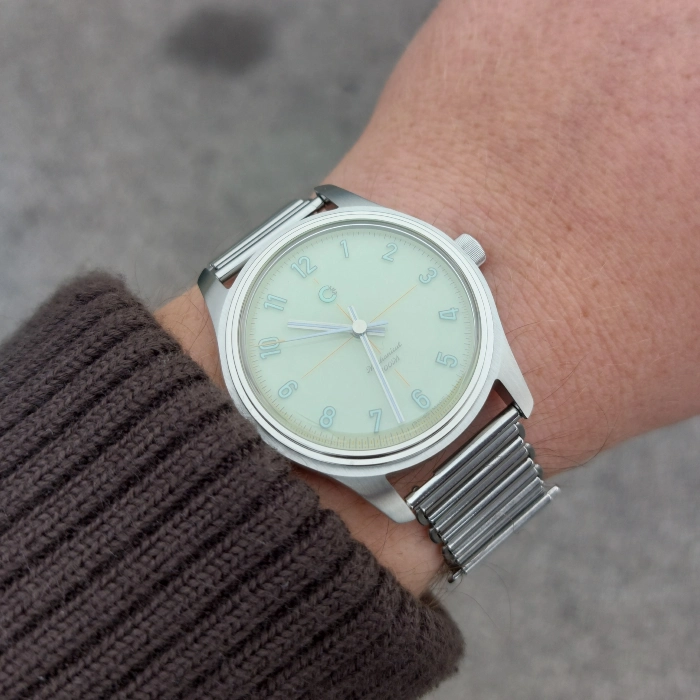
A soft, low-contrast “ghost dial” can be charming on a true vintage piece, but on a modern watch that leans so heavily on car-instrument and field-watch cues, it feels like a misstep.
The end result is more of a sporty, smart-casual watch. Calling it a field watch is, frankly, a stretch.
The hands add to that issue. Despite their brushed finish, they shift in tone quite dramatically depending on the angle. Sometimes they appear very dark, providing just about enough contrast, and sometimes they look so pale that there’s barely any contrast at all.
Aside from legibility, I would also probably change the crown. It looks nice, but because it’s a hand-winding watch, the fluting on it is slightly too fine and doesn’t provide enough grip – at least for me. Had this been an automatic, I wouldn’t have minded it at all in its current form.
Verdict?
All things considered, the Fieldtimer is a beauty. It’s exceptionally well thought out—every shape, every facet, and every small design decision, from the typeface to the hand-stack cap, feels deliberate. The finishing is excellent, and the specifications are impressive across the board.
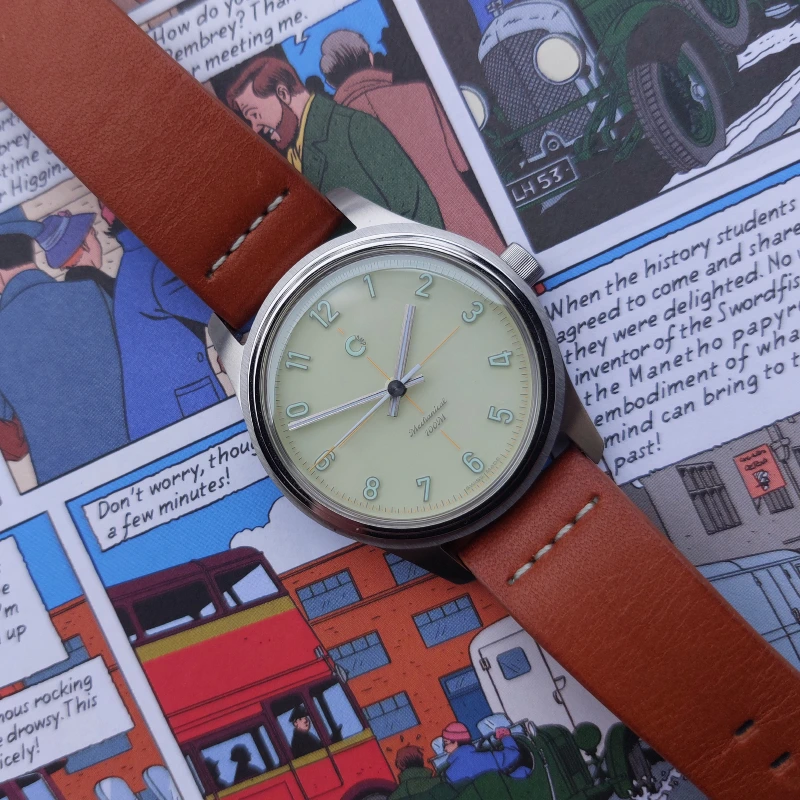
Would I be tempted to get one? Probably. But I’d love to see the legibility issues addressed, because this is genuinely a striking watch with enormous potential. With a few tweaks, it could easily become not just a visual standout, but a truly practical one as well. Here’s hoping it’s a matter of when, not if.
That said, if you’re looking for a watch that prioritises design above all else, and you see it more as a stylish watch than a purely utilitarian one, then the Camp Fieldtimer may already offer everything you could wish for.
Tech specs
- Diameter: 39mm
- Lug to lug: 47.2mm
- Lug width: 20mm
- WR rating: 100m/10 ATM
- Case material: 316L stainless steel
- Crystal: box-domed sapphire with ARC on the underside
- Movement: Sellita SW-210-1b (Elabore grade) – hand-winding, 18 jewels, hacking seconds, 42-45 hours of power reserve, adjusted to 2 positions and accuracy of +/-12 seconds per day
- Additional information: limited run of 100 pieces per color
- Available on their website for $900 (free shipping inside the US)


Thank you, Michał, for the thoughtful and detailed review! It’s encouraging to hear your thoughts on the design and honest feedback is always appreciated. I do admit this particular dial may have been influenced slightly by our 300 days of sunshine here in LA, where the shadows really do their job and pop the numerals off the surface. But on a field watch, even a sport/casual one, legibility is not to be taken lightly and fortunately the other color options do not share the same trait. We’re always working to improve the design so keep an eye out for our future releases!